On a related note – who are you hoping to recruit for the 2012 or 2016 election? With two year campaigns becoming the norm, now might be a good time to start thinking that way.
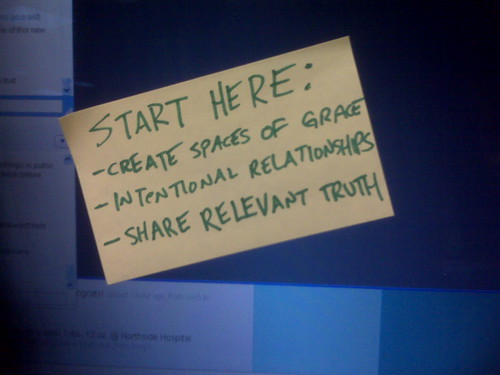
I was sharing with my life, Laurie, the other night that it’s amazing how intentional folks are on Twitter (and many on Facebook) about relationships.
I can send a txt message to 30 people and I don’t typically get any responses. I can share one message on Twitter – and within minutes 10 people from literally around the world let me know they’re praying for me. (UPDATE:I don’t mean that to say that folks who get my txt messages don’t care — see comments — but to hear or see someone actually say it does me good. I guess that’s why one of my big love languages is verbal/encouragement 🙂 ).
You really do have to be intentional about building relationships on Twitter. Otherwise it probably seems really pointless and a waste of time.
Olly says girls have skills when it comes to putting on make-up in all sorts of situations.
Tripp Fuller and Chad Crawfordscored an interview with Phyllis Tickle to discuss The Great Emergence. I’m looking forward to hearing the interview on their Homebrewed Christianity Podcast.
Many people are stillsuper buzzed about Obama’s election. However I think things are a little different for my friends over on Facebook. Does that make Facebook more conservative and Twitter more liberal? Or is just my friends?
Trucker Frank is loading his truck in Shakopee MN, where it’s snowing a bit and then he’s heading to KC.
And that’s just the tip of the iceberg! If you’re still reading this, you should probably be on Twitter. If you’re not – well then I’m talking to myself – and my friends already on Twitter ;-).
Earlier this week blogger Mike Morrell asked “what sould emergent/emerging worship look like and sound like?”
I’m sure everyone has different ideas. Jonny Baker is big into the alt.worship scene. Others like Solomon’s Porch, are big on their community of faith writing their own songs and sharing them together. Others I know could care less what the music looks or sounds like – they’re more interested in the celebration and the sharing of stories/testimonies. They admit that their mind wanders during community singing and they may start thinking about work, home or motorcycles instead.
Either way I believe our worship should be defined as “celebrating what God is doing.”
Michael points to 4 key elements (suggested by Adam Walker Cleveland) that should be a part of “emerging worship” ::
gender-inclusive language (esp. in our language for God)
a shift from a I-YOU-me & God focus, and a refocusing on the community
a passion for the biblical themes of social justice, peace and a desire to speak for the oppressed
maybe just some more songs straight from scripture (or from saints and desert fathers), letting God’s work speak for itself, instead of pressing our own interpretation onto it, and onto the congregation that will sing the song
Some may say the words to the songs don’t mean much – but I’m a big believer that they do. When I play an artist like Derek Webb, Bob Dylan or Flobots on my Zune – their lyrics move me to action (or at least increase my desire to do something). U2‘s Sunday Bloody Sunday doesn’t allow me to sit back and ignore the violence going on in the world – it calls me to action.
And likewise, as I and others have said before, when I walk into church and only sing songs about being hungry or thirsty — I’ll probably leave feeling hungry and thirsty. But if the weight of the world is on my shoulders and I can sing songs of How Great Thou Art and How Great is Our God or other songs about the strength and might and love of my God, my burden is lightened and I’m more willing to submit control of my situation to God.
Michael points out one band that is attempting meet these four keys to emerging worship, Zehnder.
I got a copy of their album and it’s definitely a mix of musical styles. A little something for everyone perhaps. (That may be something that’s missing at encounter. We tend to lean more towards the rock or the softer acoustic/unplugged rock sound.)
On Going Up, the Zehnder brothers lyrically fit the 4 points that Michael and Adam point to, while mixing in original tunes as well as a rendition of What Wondrous Love is This. Musically I wasn’t as impressed the first time I listened to the album, but upon further listening and as the words began to sink in I’ve became more and more attracted to the music.
Musically I would say several of the songs are similar in style to Simon and Garfunkle others have more of an upbeat sound with almost a choral backing, especially on the song Rise Up ::
Rise up, feel the change!
The Resurrection comes again!
Rise up, believe the change!
We’ll never be the same again!
Spirit Born seems to have it’s musical and vocal styling influenced by Sting (download the free Mp3).
You know the wind blows, wind blows where it chooses
You hear the sound of it
But you don’t know, don’t know where it comes from
Or where it goes, it goes, it goes
Yeah, you know don’t know, don’t know where it comes from
Or where it goes, it goes, it goes
Blow through me, Wind, breathe on me, Breath, make Spirit born,
All of my soul, make Spirit born, Spirit born.
And Justice Jam could be possibly be confused with a Flobots track using backing strings, a hip-hop beat and heavy social justice lyrics (listen to a sample).
For justice I bust this flow for free
Used to be blind but now I see
Through the eyes of the elders who came before me
Like Malcolm and Martin and I can’t forget Mahatma Gandhi
Take a knee, homey / Hug an old bodhi tree
Realize how to be revolutionary
Destiny is divine when aligned with the truth
That resides deep inside that g-ride of my youth
Now I got proof of insurance and a photo ID
But I choose to tell time by Mayan prophecy – Oo, Let justice roll down…
Overall I think the Zehnder brothers have created an album that challenges us to much greater themes than much of the music you’ll hear on your local “Christian radio station.” It challenges us to think about our faith and how it impacts (or doesn’t impact) our daily lives.
I’m not sure the songs are as singable in a community settings as some that Dave Andrews has written but I definitely wouldn’t object to trying them out in a community setting.
But don’t take my word for it.
Go check out the band’s website ztheband.com and then purchase their CD from CDBaby.
And while you wait for the album to arrive, check out their 2003 rendition of Song of Peace ::
Give the band a listen and let me know what you think.
It reminds me is that human beings are still tribal. As an example, if you check your own address book, or think about your family and friends, they probably number no more than two hundred people. We may have more in the book, but it’s rare for our intimates to be greater than two hundred people. Our networks are geographically dispersed these days. Even if your network is mostly in one location, people are so busy living that it can be difficult to stay in touch. Twitter is a facsimile of living and working in proximity for me, and provides something unique, too
Jon touches on a few things he’d like to see on twitter. I’d ditto those as well and add that I’d like to see easy ways to track physical locations as well. There are other social networks that will track your location. BrightKite will even alert you when other users or friends are in your area. A very cool feature indeed. But there’s not a good BrightKite app for Blackberry yet, so that’s a bit of a bummer for me and will probably keep me from switching anytime soon.
I also find this line from Jon’s article interesting, “but it’s rare for our intimates to be greater than two hundred people.”
I think that’s true in so many arenas of life. I only follow 66 people on twitter (and leave the SMS/txt message updates off for all but maybe 5 people) and while I have over 300 “friends” on facebook I really only keep up with/track half of them (if that). But of course it is nice when something catches my eye from those other 150ers and I can get updates on them as well.
I also see the 200 people limit playing out in churches/workplaces and more. It’s really hard to get to know more than 200 people or so in any regular setting. Even if there are 15,000 people in a room, do you really know more than 200 of them? Can you know more than 200 and build real relationships with them?
I think that’s what I love about online communities like Twitter. I know 10xs more about folks like @Jess_Hays and @sgalloway since they joined Twitter than I ever learned about them just seeing them for a couple hours on Sunday morning. The same goes for folks who constantly fill out surveys on Myspace. I learned tons of things about folks in my tribe thanks to them taking some time to be intentionally open.
What about you? What makes Twitter beautiful for you? Do you agree that it’s rare to have intimate relationships with more than 200 people? Do you think that number is much higher or less?