
re: Google Earth updates Jos Nigeria


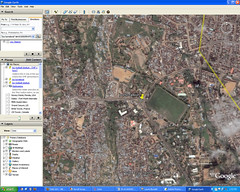
Screen shot of Jos Nigeria
Originally uploaded by Jonathan D. Blundell.

Back in July I reported that Google Earth had updated their satellite images of Jos, Nigeria (where Rob and a group of others from Lakepoint spent two weeks).

I shared the info with Mike Blythe, a missionary there working with the ECWA hospital.

Mike just sent me a link for a killer KMZ file that highlights lots of areas around Jos – including many of the sites that we saw and worked at while we were there.

To view it – be sure you have Google Earth installed and the open the link. It should automatically populate your “My places” with all the sites in Jos.

Big props to Mike! Makes me really want to go back there.

Related ::
Google Earth
the Jos, Nigeria KMZ file
SSL :: Google Earth updates Jos Nigeria
Mike Blythe’s blog
Google Earth :: Jos Nigeria KMZ file
Photos from my 2006 trip to Jos
Photos of the football/soccer stadium mentioned in the KMZ file :: 1 2 3 4 5 6 7 8
CWF photos from Nigeria 2007
CWF :: Christian Wrestling Federation

How Pixar builds collective creativity

There’s a story making it’s way around the interwebs from the Harvard Business Review about How Pixar Fosters Collective Creativity. Pixar’s the CGI animation studio (originally a division of LucasFilms, then owned by Steve Jobs and now a wholly-owned subsidiary of The Walt Disney Company) that put out great movies like Toy Story, Monsters Inc. Cars, etc.

Since they released Toy Story in 1995, the studio has earned thirteen Academy Awards, three Golden Globes, and one Grammy.

Pixar’s President Ed Catmull writes ::

A few years ago, I had lunch with the head of a major motion picture studio, who declared that his central problem was not finding good people—it was finding good ideas….

Unlike most other studios, we have never bought scripts or movie ideas from the outside. All of our stories, worlds, and characters were created internally by our community of artists. And in making these films, we have continued to push the technological boundaries of computer animation, securing dozens of patents in the process.

In the article Catmull shares 3 key organizational principals that guide Pixar ::

  • Everyone must have the freedom to communicate with anyone
  • It must be safe for everyone to offer ideas.
  • We must stay close to innovations happening in the academic community.

Imagine what a church could look like that implemented these ideas! An environment where everyone recognizes that they are truly a part of the priesthood of believers and that all the believers around them are as well.

Brian mentioned this morning that at encounter we try and view everything as an experiment. There are some things we try that work great and then we work to make them even better — and there are things that don’t always work out as we hope so we scrap the idea and move on.

What if everyone really felt like they could really take ownership in ideas and participate in the ongoing conversation about God and life? What if everyone realized their ideas would be listened to, valued and built upon?

How differently would we view one another? How different would our conversations be?

I hope in my own community group and all of our community groups (as well as our church as a whole) we continue to foster community and environments where everyone feels a valuable part of the experience and process.


How good and pleasant it is
when God’s people live together in unity!

It is like precious oil poured on the head,
running down on the beard,
running down on Aaron’s beard,
down on the collar of his robe.

It is as if the dew of Hermon
were falling on Mount Zion.
For there the LORD bestows his blessing,
even life forevermore. – psalms 133
quote for the evening

The authority and submission that Scripture envisions gives more authority to the church than does Rome, trusts more to the Holy Spirit than does Pentacostalism, has more respect for the individual than Humanism, makes moral standards more binding than Puritanism, and is more open to the giving situation than “The New Morality”
-John Howard Yoder
As quoted in Reimagining Church by Frank Viola

Lingering Questions

Tripp Fuller shared a great thought today via his blog:

Listening to both parties each night has made me confident that the church really needs to quit outsourcing its vocation.

Makes a world of sense to me. Seems like the less the church does, the more the government feels it needs to step in to care for people. I can agree with much of the Democratic view of things because they see the need to step in and help the helpless. Yet, I still have to question if that’s really the government’s role. If the church really did their job, I think we’d be a lot closer to solving the world’s problems – than depending on the American Government to do so.

Kevin Hendricks and I seem to be asking some of the same questions as well and trying to decide how someone who claims to be a follower of Christ also claim to put country first. Seems backwards to me.

Tripp also shares several questions raised by Warren Carter (who is on the Homebrewed Christianity podcast last week – with part 2 to be posted this week):

Here are Carter’s questions:

What does it mean to be…..

  • rich Christians in an age of hunger?
  • well fed Christians in an age of poverty?
  • vacation-homed Christians in an age of homelessness?
  • overclothed Christians in an age of nakedness?
  • highly entertained Christians in an age of militaristic violence?
  • Sermon-on-the-Mount-shaped Christians in our age of empire?

Finally, thought this was an interesting contradiction in Sara Palin’s speech last night…

First she rips on Obama because “Al Qaeda terrorists still plot to inflict catastrophic harm on America … he’s worried that someone won’t read them their rights?”

Then she applauds John McCain because “To the most powerful office on earth, he would bring the compassion that comes from having once been powerless … the wisdom that comes even to the captives, by the grace of God.”

Got answers? The world is listening.

related ::
tripp fuller :: preaching the sermon on the mount and some more substantive lingering questions
barack obama’s acceptance speech
sara palin’s RNC convention speech
kevin hendricks :: country first
SSL :: question for today

Community fertilizer

Checking in on one of the groups I’m a part of on Roov.com.

The question was asked :: What WORKS in cultivating community? What’s the fertilizer that causes rapid and healthy growth here?

Thought this was a great response of practical (and actual) things another member was doing ::

-sparking up more conversations with what look like new people at our church
-inviting old and new friends alike over for a dinner or coffee once a week
-saying hello to people *between* Sundays more often

And as for the results…it’s been INCREDIBLE so far!

What have you found that works great for building community (offline)?

Kingdom of God leaders

I’ve been reading Frank Viola’sReimagining Church” over the last week or so. It’s been a great companion to go along with Brian’s message series (priests in the hood). The book also seems to apply directly to what I envision for our community groups at encounter (and beyond).

This morning I read Luke 22:25-26:

Within minutes they were bickering over who of them would end up the greatest. But Jesus intervened: “Kings like to throw their weight around and people in authority like to give themselves fancy titles. It’s not going to be that way with you. Let the senior among you become like the junior; let the leader act the part of the servant.

As community group leaders/facilitators/hosts I think Viola makes some great points about what we should avoid striving for and what we should strive for:

  • in the gentile (secular) world, leaders operate on the basis of a political, chain-of-command social structure — a graded hierarchy. in the kingdom of God, leadership flows from childlike meekness and sacrificial service.
  • in the gentile world, authority is based on position and rank. in the kingdom of God, authority is based on godly character. note Christ’s description of a leader: “let him be a servant,” and “let him be as the younger.” in our Lord’s eyes, being precedes doing. and doing flows from being. put differently, function follows character. those who serve do so because they are servants.
  • in the gentile world, greatness is measured in prominence, external power and political influence. in the kingdom of God, greatness is measured by humility and servitude.
  • in the gentile world, leaders exploit their positions to rule over others. in the kingdom of god, leaders deplore special reverence. they rather regard themselves “as the younger.”

I hope and pray that we’re all being leaders/facilitators/hosts that fit in with the kingdom of God model and not the gentile/worldly model that surrounds us everywhere we go. I also pray that each of us are encouraging our group members to do the same. By becoming servants to all, leadership will be a natural extension to them all.