This is way cool — the 10 day give

From the website:

The 10 Day Give is a challenge that is designed to help us get our minds off of ourselves and start thinking about how we can help others.

The thing is, I think most people really want to make other people’s lives better, but with everything going on all around us all hours of the day, we just don’t get a chance. This is an opportunity to choose, on purpose, to give of ourselves. There really are hundreds of opportunities that we overlook each day. My goal is to just grab hold of one of them each day.

For some people that means giving money, for others time is far more precious than money, and for others it may mean their expertise in an area. But, no matter who you are, we all have something to give.

It could be taking someone out to lunch, it could be babysitting for an overworked mom, it can as simple as giving your precious time by taking your mom to the park to talk. There are no rules, no judges, and no right or wrong ways of completing the challenge.

But, I encourage you to sign up for the challenge and decide to give whatever you can – it’s only for 10 days. And who knows, maybe it will become a habit.

Starting on October 10th, 2008 we are going to give something to a different person, each day until October 19th, 2008. It doesn’t matter what the gift is, how much it costs, who it is given to, or how it is given. The point is to just to give – on purpose. We hope you decide to join us.

HT – Andrew Jones

re-posts re: church

Was reading The New Christians today at lunch and came across a familiar name :: Jonny Baker.
Thomas introduced me to Jonny a while back and while searching my site for a few things I came across these quotes I shared back in 2006 from Jonny.

This was an ad for a church on Jonny’s site:

You love God but you just can’t do Sunday morning style church?
You’re really not into singing songs all the time or you don’t believe that singing songs is the only way we can worship God?
You would like to be part of a church where you are accountable to each other and are responsible for helping each other grow?
You’re tired of professional Christianity and you just want to be church like it was with Jesus and his followers back in his human days?
You believe Church is more fluid than a building or tradition.

And how about this…

Can we imagine church as ::

  • church beyond gathering?
  • church beyond once a week?
  • church as always on connectivity to christ and one another?
  • church where community is the content?
  • theology and resources of church being open source?
  • church valuing the wisdom of the crowd rather than the knowledge of the expert?
  • our church/spirituality being easily found by seekers because we tag it that way?
  • an ethos of low control and collaboration?
  • an economy of gift?
  • church as spaces for creative production and self publishing?
  • church as providers of resources for spiritual seekers and tourists?

I hope its coming true.

Some Beautiful updates

I don’t normally plug our podcast here too much (at least I don’t think so) but thought I’d give you a heads up on some great interviews we’ve had recently and a few that are upcoming.

Be sure and check out somethingbeautifulpodcast.com to listen to all our past, present and future shows.

This week on the show we have the first part of my interview with Greg Garrett. Garrett’s an English professor at Baylor University and also a lay-pastor at St. David’s Episcopal Church in Austin, Texas. He recently wrote a great book – “Stories from the Edge A Theology of Grief” based on the summer he spent as a chaplain in Austin, Texas. I talked to Greg about how he dealt with his own personal “demons” and how he was led into the chaplaincy and some of what he learned in the process. Great stuff.

Also, last week we talked with Mark Batterson, pastor of National Community Church in Washington DC. Batterson recently released his second book, “Wild Goose Chase” and we talked about the book, the adventure of chasing the Holy Spirit and how Batterson has seen it play out in his own life.

Coming up we have the second half of my interview with Greg Garrett, as well as an interview with Frank Viola and a two part interview with Trucker Frank (aka Frank Schutzwhol).

I think they’re all stories worth talking about (whether you agree or disagree with the particular story) so be sure and check them out and let us know what you think.

Also, if you have a story, poem, or message that you think our listeners would love to hear — send it to us. You can send it as text only or if you’d like to record it in your own words you can send an mp3. Send all your submissions to :: somethingbeautifulpodcast (at) gmail (dot) com.

www.somethingbeautifulpodcast.com

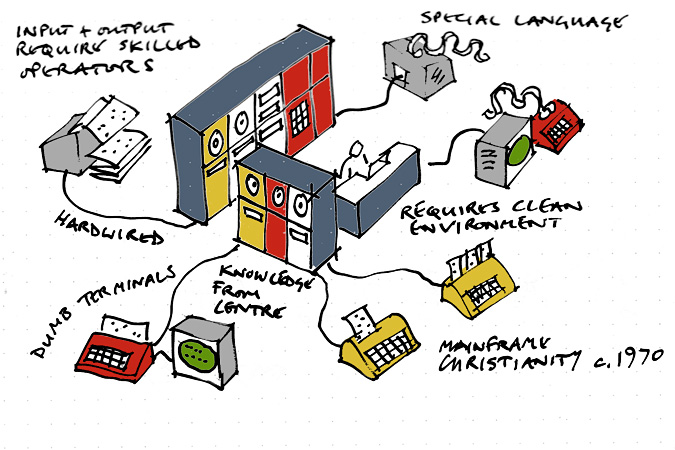
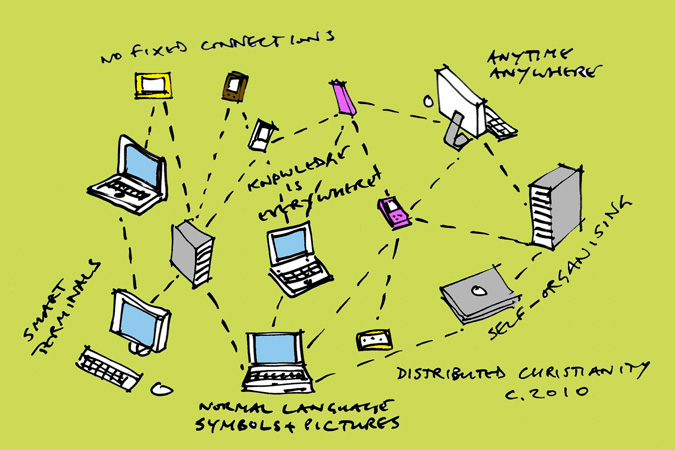
Mainframe v Distributed Christianity

I had a great chat with Frank Viola yesterday, can’t wait to share it on the podcast in a few weeks.

We discussed his book Reimagining Church along with the idea of organic churches. Thought this was a great illustration shared by @darrinreeves today (you can click on the images to see them larger) ::

Which would you prefer? Which do you feel like you’re apart of? Which would you rather be a part of?

the great emergence conference

Plans have been made for the Great Emergence Conference to take place in Memphis this coming Dec.

The book is based around Phyllis Tickle’s upcoming book by the same name.

The Great Emergence National Event is a unique and freshly designed event built on innovative adult learning techniques including interaction, participation, and inspiring content on the current state of and future possibilities for Christianity.

Around the four main sessions with Phyllis Tickle, participants will also enjoy the daily office — thrice daily times of prayer — based on Phyllis Tickle’s bestselling book, The Divine Hours, in the majestic and historic Cathedral of St. Mary in Memphis, Tennessee, which will be bedecked with Advent greenery.

Memphis and St. Mary’s Cathedral hold a pivotal place in American history. Memphis was the scene of much racial strife during the Civil Rights Movement, culminating with the assassination of Rev. Martin Luther King, Jr. on April 4, 1968. The next day, hoping to quell a burgeoning riot, many of the city’s pastors, priests, and rabbis gathered at the Cathedral. In an impromptu move, the dean of the Cathedral took the processional cross from the church’s altar and led a procession of the city’s clergy down Poplar Avenue to city hall, where they petitioned the mayor to end the sanitation strike that King was in town to protest. As an important location of the emergence of civil rights in 20th century America, Memphis and the Cathedral are a poignant place to discuss the emergence of the church in the 21st century.

Along with Tickle, a number of folks will be hosting workshops during the event (I think half of them have been on the Homebrewed Christianity podcast)::

Tony Jones, national coordinator of Emergent Village and author of The New Christians: Dispatches from the Emergent Frontier

Doug Pagitt, founder and pastor of Solomon’s Porch (Minneapolis, Minnesota) and author of A Christianity Worth Believing: Hope-Filled, Open-Armed, Alive-and-Well Faith for the Left Out, Left Behind, and Let Down in Us All

Peter Rollins, founder of ikon (Belfast, Ireland) and author of The Fidelity of Betrayal: Towards a Church Beyond Belief

J. Brent Bill, executive vice president of the Indianapolis Center for Congregations and the author of Sacred Compass: The Art of Spiritual Discernment

Lisa & Will Samson, members of Communality (Lexington, Kentucky) and co-authors of Justice in the Burbs: Being the Hands of Jesus Wherever You Live

Joseph Myers, author of Organic Community: Creating a Place Where People Naturally Connect

Tim Keel, founder and pastor of Jacob’s Well (Kansas City, Missouri) and author of Intuitive Leadership: Embracing a Paradigm of Narrative, Metaphor, and Chaos

Jonathan Wilson-Hartgrove, co-founder of Rutba House (Durham, North Carolina) and author of New Monasticism: What It Has to Say to Today’s Church

Karen Ward, is Abbess of Church of the Apostles, Seattle, an intentional, sacramental community in the way of Jesus Christ.

Sybil MacBeth, is a mathematics instructor, a dancer, and a doodler. Her 2007 book Praying in Color: Drawing a New Path to God introduces a prayer practice that is meditative, visual, active and playful. She lives in Memphis, Tennessee with her husband, Andy, who is an Episcopal priest.

If you’re interested in going – sign up now. The cost is $145 with early registration or $195 after Nov. 5.

Register online with coupon code JBLB (won’t save you any money but if I can get 20 folks to sign-up then I’ll be able to join you there :-))

find out more at www.thegreatemergence.com

Reimagining Church

Finished “Reimagining Church” last night. A good followup to Frank Viola’s book “Pagan Christianity” The book picks up in many places where Pagan Christianity left off – but also works as a standalone piece as well. As the summaries and publishers suggest, Pagan Christianity deconstructs the church and Reimagining reconstructs it.

Don’t know if it fully reconstructs it – but it definitely get’s the ball rolling.

Viola explains in the introduction:

Herein lies the purpose of this book: to articulate a biblical, spiritual, theological, and practical answer to the question, Is there a viable way of doing church outside the institutional church experience, and if so, what does it look like?

Many could see Viola as a threat to the church – especially the institutional church – but perhaps that’s why I really enjoy the book. He adds in the introduction, “I’m writing this volume because I love the church very much.” It’s the institution that he (and I tend to) have problems with. (Viola later suggests that “institution is any patterned human activity.”)

Viola argues that the institutional church as we know it is ineffective and also without biblical merit. That our current churches are constructed more on programs and rituals than relationships. That institutional churches are built around a highly structured “worship service” where the audience is separated or set-apart from the professionals (pastors, ministers, worship leaders, etc.).

In the institutional church, congregants watch a religious performance once or twice a week led principally by one person (the pastor or minister), and then retreat home to live their individual lives.

In place of the institutional church (which Pagan Christianity explains came about through many Greco-Roman customs — especially during the Constantine era), Viola argues for a more organic approach to Christianity. One in which there is no separation between lay-persons and the clergy. One in which each person’s spiritual gifts are valued and each person takes part in the group gatherings. One that meets in homes during the week rather than multi-million dollar sanctuaries/malls.

Viola compares these two views of church throughout the book, but perhaps the most beautiful illustration is one from Hal Miller.

Miller says that institutional churches are like trains. They go a certain direction and continue on that direction making a lot of noise and blowing a lot of smoke. They’re easy to find, hard to stop and can’t change direction without coming to a crawl and someone flipping the switch on the track.

Organic churches are more like people walking through a neighborhood. They move much slower but can turn at a moment’s notice. Because of their slow pace they can be genuinely attentive to the world around them, as well as to the Lord.

And because of it’s organic nature, the organic church is always growing and reproducing. And no matter where it grows or shows up, this organic church should always reflect the same DNA elements ::

  • It will always express the headship of Jesus Christ in His church
  • It will always allow for and encourage the every-member functioning of the body
  • It will always map to the theology that’s contained in the New Testament
  • It will always be grounded in the fellowship of the triune God

Those first two points are probably the stickiest points for everyone and likely why Viola spends a vast majority of the book discussing them. Unfortunately, I felt like he spoke more on what that didn’t look like than what it did look like.

In addressing these issues, Viola argues that the body of Christ must not be about the hierarchy systems of the world but must instead be about mutual edification and mutual submission. I personally believe this is a lot of what Christ spoke of in John’s 1st letter ::

I’m praying not only for them
But also for those who will believe in me
Because of them and their witness about me.
The goal is for all of them to become one heart and mind—
Just as you, Father, are in me and I in you,
So they might be one heart and mind with us.
Then the world might believe that you, in fact, sent me.
The same glory you gave me, I gave them,
So they’ll be as unified and together as we are—
I in them and you in me.
Then they’ll be mature in this oneness,
And give the godless world evidence
That you’ve sent me and loved them
In the same way you’ve loved me. (john 17)

Imagine the impact this would have on the world around us if we all truly lived as one. Where no one person took precedence, where church decisions were based on consensus rather than dictatorship or democracy. If the members of Christ’s body are truly submissive to Christ and to one another, I believe Viola would argue that this would turn the world upside down.

Yet for someone who’s grown up in a traditional, institutional church, the idea of a church led not by a man (or woman or group of men) but by the headship of Christ (through the Holy Spirit) is foreign. And yet I can definitely understand the reasoning behind it. I can agree with the Scripture Viola uses to make the point — but to picture it and understand how you would bring that about is foreign to me (and probably 99% of “church-going Christians). Perhaps this will be addressed in future books.

It does look as though this is part of several more in the “series” as Viola mentions two more books coming out in the near future. “From Eternity to Here” is the next one on the map.

Regardless, this book leaves me hungry for seeing something more in our churches today. It’s a great supplement/compliment for what I’m feeling/thinking/dreaming in my soul. It leaves me aching for truer community, where there are true spaces of grace, intentional relationships and God experiences are shared by all.

I hope to come back and share some of the many quotes/thoughts that stood out to me in my reading — but I just started a new book by Greg Garrett, “Stories from the Edge – A Theology of Grace” so it might take me a week or so to get back to “Reimagining Church” :-).

related ::
www.reimaginingchurch.org
www.housechurchresource.org
www.ptmin.org
SSL :: looking back at a house of prayer
encounter :: priests in the hood
encounter :: tribal faith