Getting things done

I’m really impressed with the Getting Things Done system. I haven’t figured out a way to make it work for reals in my life yet – but I’m trying to get into the swing of things.

I’m curious if anyone has any insight on this. I started a new job in December for the DCCCD. As part of my job there are e-mails flying from every which direction about all sorts of curriculum based/catalog issues. As I’m learning my job I’m trying to process a lot of these emails but I also know that many of these things really don’t have a lot to do with me (or maybe they do and I just don’t realize it yet). I was fairly successful at keeping my e-mail inbox at 0 in my previous jobs but I’m not doing as well here.

We also use Novell GroupWise (argh!) and it stores all the messages on the server – so even if I moved e-mails to other folders to get them out of the way – apparently they’re still saved on the servers and IT doesn’t like all those e-mails clogging up the system.

UPDATE: Forgot to add that we tend to print almost all emails for record keeping – especially when it comes to any changes to the catalog and curriculm.
Any thoughts or helpful tidbits?

re: Social networking and the church

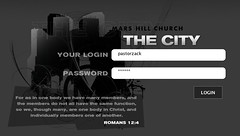
the city

Found some more info on Mars Hill’s social network, The City:

The site is being built around physical communities not as much as around online communities.

One of the design principles of The City, which has guided virtually every decision we’ve made, is that the physical is more important than the virtual. This subtle but significant difference provides the foundation for understanding how this new thing is going to work…

On my Facebook page, I’ve got dozens of friends. Of those friends, I would imagine that about one third are actually in the Seattle area. The other two thirds are people literally all over the world. While there is a certain cool factor in having a virtual Rolodex of everyone I’ve ever known, is there anything more to it than that? Sure, if I’m planning a trip out to one of the areas where they will be, it’s rather convenient, and I get to find out that my college friend is eating a ham sandwich (a la Twitter), but that doesn’t change my life or their life for that matter. When you’re trying to build an intentional community, Facebook just doesn’t cut it. There are too many off topic, off mission sorts of diversions that the game aspect of the site dominates any mission it could try to carry.

Now, Facebook can be incredibly missional for the 1% that choose to use it as a mission field and network specifically with that in mind, but I’m trying to think along the lines of how you get the 80% to that level. The framework will either make a compelling community, or it will not. I don’t believe Facebook ever will do that for the 80%.

More specifically they’re building the site around physical neighborhoods.

Simply, your neighborhood is everyone that lives near you. Pretty basic eh? So why is this a cool concept? Let’s look at a concrete yet fictional example.

John is a community group leader in Ballard; he hosts his group just a little down the road from the public library off Market. He’s got a relatively new group with just five folks in regular attendance. He invites people to his group regularly, but they live all over the place! Ballard draws people from all over Seattle (and beyond), and finding the right people has been tough.

Jim is new to Mars Hill. He attended his first service, stopped by The City kiosk afterwards, and signed up to be “connected”, whatever that means. The volunteer that helped him was nice enough, but Jim doesn’t know what he’s supposed to do next. He lives near the old firehouse on Market, in fact, he works as a Brazilian Jiu-Jitsu coach at the studio there. If only John knew Jim was in his backyard…

This is where the ‘neighborhood’ thing I checked into the code this morning comes into play. John would see in The City that a new guy showed up in his neighborhood (without having to dig for it), maybe The City would even say, “hey, you’re the closest community group!” and John could reach out to Jim with a couple of clicks.

Love it!

Social networking and the church

I’ve written about social networking (i.e. MySpace, Facebook, etc) here before. I’ve also written about the idea of churches getting behind these networks and putting them to use for marketing, announcements, building community, etc. etc.

I haven’t heard a lot of feedback other than on the techie side of things. I read recently about Mars Hill’s social networking strategy over at digital.leadnet.org.

Here’s an overview:

  • Pastor Mark Driscoll’s Facebook profile has 4000 friends
  • Less than 20% of these friends are from the Seattle area
  • He has apps to read in his blog, link to his books from Amazon, play videos from their Ask Anything sermon series, and read in Mars Hill RSS feeds
  • He gets 20 messages and wall posts a day
  • Mark Driscoll’s Myspace profile has 400 friends

In addition to this, Dustin told digital.leadnet about an internal project they’re working on – “Our IT department is currently developing our own social network, the City, that will be used for almost all communication within the church.” More info on their soon-to-launch social network here.

This is very cool in my book (of course Mars Hill apparently has a full IT team and their own blog). They’re building the site on Ruby on Rails. Not real familiar with that software or “programing language” but it looks cool. I’m looking at doing something with Elgg.org for now. But I’m seeing more folks using Ruby on Rails. Might be worth looking into.

So the techies are interested in all this and implementing it – but for me part of the thrill of implementing a social network for encounter or other churches is the challenge aspect of it. I wonder how enthused average users or church members would be in using it.

So I put together a quick survey over on the encounter blog. I’ve plugged it via our Twitter feed, our Facebook group, a MySpace bulletin and of course here. I’d encourage you to take a second and fill out the form, regardless of if you’re an active part of encounter or not. And I’d love for you to push the survey on your own blogs as well. The more input the better.

And yes – you can remain anonymous in filling out the form.

The Shock Doctrine

Thomas shared this video via Facebook:

DIRECTED BY JONÁS CUARÓN. Alfonso Cuarón, director of “Children of Men”, and Naomi Klein, author of “No Logo”, present a short film from Klein’s book “The Shock Doctrine: The Rise of Disaster Capitalism.” http://www.shockdoctrine.com

Powertalk podcast

My buddy Rick Walker asked me to come join him last night at Power FM for his show Powertalk. It was open line so the topics ran from persecution, blessings and curse to end times and cow tipping.

At one point I think Rick got a little carried away and called me “the theological voice of our generation.” Luckily we passed that title off to a caller before too long.

I had also forgotten how funny it is to hear yourself on the radio or other recordings. I always think I have a much higher voice until I hear a recording of my voice or hear myself talking with headphones on. Crazy stuff.

Anyways, all of that to say the podcast of the show is up.

You can listen here. Be sure and listen to a cameo phone call from my best friend Matt.