From today’s WDL
By JONATHAN BLUNDELL Daily Light staff writer
Tuesday, April 4, 2006 11:55 AM CDT
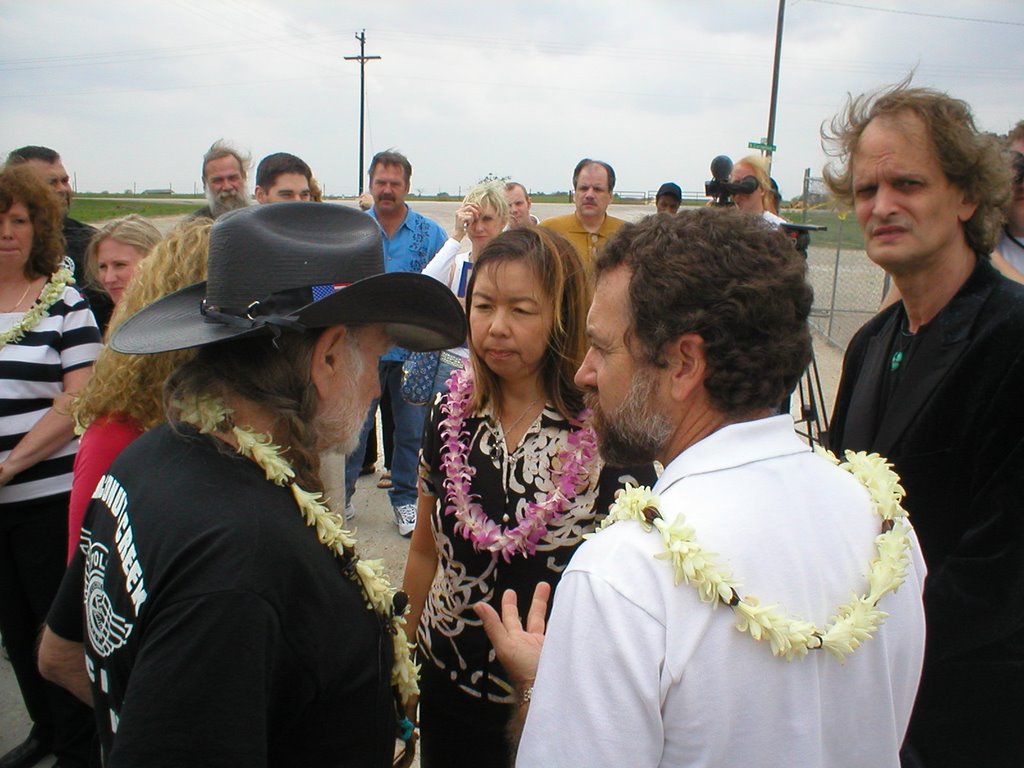
CARL’S CORNER, Texas — At a small truck stop just south of the Ellis County line, music legend Willie Nelson and friends, including Academy Award winner Morgan Freeman, are hoping to change the world, one community at a time.
Carl’s Corner has become a landmark to motorists along Interstate 35 over the years and now Nelson hopes it will become a model for the country’s use of alternative fuels.
Nelson introduced his plans at a press conference and ground breaking Saturday afternoon.
“We’re kicking things off in Texas from here,†Hill County native Nelson said. “I came from around here and I think what we’re doing will be a light at the end of the tunnel for farmers everywhere.â€
That light at the end of the tunnel Nelson is hoping for is biodiesel, the process of turning feedstock oil and used cooking oil into working fuel for diesel engines.
 The Carl’s Corner truckstop has already begun selling BioWillie fuel to truckers and other interested motorists, but with a partnership between Nelson and Pacific Biodiesel Inc., a new refinery plant will be built on two acres behind the landmark destination, that has a capacity to refine 8,000 gallons of fuel a day, or two million gallons a year.
“The idea is for a community-based facility,†Nelson said. “This is important because we’re starting wars over oil. This will help truckers and small time farmers that we’ve neglected for too long.â€
As a part of the partnership, Elgin Cotton Woolmill in Hill County will provide processed cotton seed oil, grow by local farmers, on local farms.
The oil will then be processed into diesel fuel at the refinery.
During off-season months, when cotton is not being grown, the refinery plant will utilize recycled cooking oil for the fuel.
The biodiesel fuel can be used in most late model diesel engines with no changes or modifications to the engine. Older engines may need to change out rubber hosing before using the fuel.
“This all started as a dream 10 years ago in Hawaii,†Pacific BioDiesel president Bob King said. “On Maui we were looking at how to get rid of used cooking oil. On an island that can become a big problem. We found a solution in biodiesel.â€
King and his wife Kelly formed Pacific BioDiesel and built their first two plants in Maui. Soon they were asked to build a plant in Japan and have now built plants in Oregon, Nevada, Pennsylvania and Virginia.
“After we ran into Nelson, things really started happening,†King said. “The dream is getting bigger now and we see this as community-based biodiesel production. We make our fuel from the crops grown in the community and refine it in the community and we sell it in the community. That leads to lots of great things such as jobs in the community. And we also isolate variables in the fuel process. It’s real sustainable.â€
King said that after 10 years of use he and his company are very comfortable using the fuel.
“Nelson brought us to Texas,†King said. “And now we’re going to use cotton seed oil or used cooking oil to produce two million gallons of fuel for this community. Every community will experiment with what works best in their community. Cotton can’t be grown in all areas, but the local farmers know what grows best and they can rotate their crops to reduce the need for pesticides.â€
The plant will be designed for multi-feedstock, so other feed crops can be grown and used as well. The process takes about five days, from the time the feedstock enters the refinery, till the time the biodiesel fuel is ready.
“This is a unique process,†King said. “The local farmer is growing the fuel and once it’s done in the refinery we have ASTM (American Society for Testing and Materials) spec. biodiesel.â€
If construction goes as planned, the refinery plant is scheduled to open July 4.
“We’re counting on local farmers to grow the fuel and for local restaurants to ‘supersize’ their fries for recycling their cooking oil,†King said. “And July 4 will be our independence day.â€
Brian Lindgren with Elgin Cotton Woolmill said the plant would be a big boost to the local farmer.
“We’ve been in this business for 100 years,†Lindgren said. “We buy cotton seeds from the local farmer to turn into cotton seed oil. And any market we can find for cotton seed oil helps all our farmers.â€
Carl Cornelius with Carl’s Corner Truck Stop said initially the idea of biodiesel was scary.
“Nelson called me up and said he wanted to put biodiesel in here,†Cornelius said. “That was kinda scary. But we’ve heard nothing but good comments from all the truckers who use BioWillie. Some say it increases their mileage by a couple miles more per gallon. That can add up to one-fifth better mileage and it’s one-fifth less pollution. Some guys are coming in here saying how great it is with tears in their eyes.â€
Another advantage of biodiesel is less wear and tear on the engine because of the high lubrication aspects of the fuel.
The fuel also has a very high flash-point, 300 degrees, so it can be shipped and stored without hazardous material warnings.
Mike Nasi with the Biodiesel Coalition of Texas said biodiesel is a part of the future for Texas.
“We represent a family of the biodiesel industry,†Nasi said. “We have to work with the state legislature, Washington and others on biodiesel. There are lots of areas that need to be cleaned up and biodiesel is part of the solution. Think about using biodiesel in the military or on marine crafts. This is a biodegradable fuel for the open waters and seas. It benefits our national security and reduces our dependence on foreign oil. The industry in Texas is doing very positive things.â€
For Nelson, it was his wife who brought him into the biodiesel industry.
“I got into biodiesel accidentally from my wife, Annie,†Nelson said. “Three years ago she wanted to buy a Volkswagen Jetta that runs on biodiesel. The car ran good and clean. So I decided to buy a Mercedes. We took it over and filled it with this ‘vegetable oil.’ We heard later that the Mercedes people almost fainted, but the car still runs wonderfully.â€
Nelson said with his personal interest in biodiesel and his work with Farm Aid, he put “two and two together.â€
“This will help our farmers get out of the hole they’ve been in,†Nelson said. “Our country’s agriculture has been on the bottom rung of the ladder for some time. We’ve lost over eight million farmers over the last 20 to 30 years and this is a light at the end of the tunnel.â€
Nelson said farmers can now produce their own fuel, on their own property, with the community refineries or smaller farm-based refineries.
In Japan, Pacific Biodiesel was contracted to build a refinery plant for a Kentucky Fried Chicken franchise. The plant processes used cooking oil from 60 restaurants and produces enough biodiesel to completely power one KFC restaurant, as well as numerous cars and trucks.
“Biodiesel and ethanol are the future,†Nelson said. “All these things combined will help us reduce our dependence on foreign oil. The president said recently that Americans are addicted to oil. I’ve been addicted to a lot of things, but I didn’t know I was addicted to oil. Now I’m going to get off of it as soon as possible.â€
Nelson said he’s also used biodiesel on his tour buses whenever possible.
“We’re running biodiesel 100 percent of the time, whenever we can find it,†Nelson said. “It’s still hard to find it in some areas, but we hope to change that.â€
Nelson also hinted that Carl’s Corner would offer E-85 in the future as well. E-85 is an alternative fuel for gasoline-powered vehicles, based on a mixture of gasoline and ethanol.
Currently only 1 percent of American cars run on diesel fuel.
“I’m concerned about the future of America,†Nelson said. “We need to start growing our own fuel and quit being dependent upon foreign oil. It’s going to be a great help financially to the farmers. There’s a much greater bottom line on fuel than there is on food.â€
Actor Morgan Freeman was also on hand to share his support for the project.
“Nelson and I met years ago doing a movie in Hawaii,†Freeman said. “And now we find ourselves interested in this same problem. We’re killing ourselves with our use of energy and this is one of the healing agents. I see a great future for biodiesel around the world.â€
As a principal partner in the project, Nelson said he was very invested in the refinery plant.
“We’ve invested quite a bit of time and money into this project,†Nelson said. “I thought I had discovered something unusual when I first found out about biodiesel, but it turns out we’re still 10 years behind most other countries of the world. I got involved through Farm Aid and I’m working to get others involved as well. Knowledge is power. We have to increase the supply side, because there is a definite demand side. Fuel prices will continue to increase, but this fuel source should remain constant.â€
“If each community can have their own plant, we don’t have to worry about other areas or countries causing our fuel prices to increase,†Nelson’s wife Annie said. “There are no variables to be determined by other countries.â€
Nelson and Freeman followed their announcement Saturday with a tour of a similar facility in Durant, Okla., on Sunday.
There are nearly 50 biodiesel refinery plants across the country at this time.
Like this:
Like Loading...