In case u missed it gas is 12 cents in Venezuela
—
Mobile Email from a Cingular Wireless Customer http://www.cingular.com
In case u missed it gas is 12 cents in Venezuela
—
Mobile Email from a Cingular Wireless Customer http://www.cingular.com

Will commuter rail ever return to Waxahachie?
According to the North Central Texas Council of Governments, the plan is to expand commuter rail to the city within the next 30 years.
With increasing growth and increasing numbers of commuters, the NCTCOG has begun looking at the future of transit rail within the North Texas region.
Along with the Dallas Area Rapid Transit, Denton County Transportation Authority and the Fort Worth Transportation Authority (The T), NCTCOG completed a comprehensive rail corridor study in 2004 that shows possible service to and from Waxahachie, through Lancaster and Red Oak.
The NCTCOG Regional Transportation Council is supporting the creation of a 260-mile rail system over the next 30 years.
A variety of technology and transportation options were considered but other than a line connecting Plano to McKinney, the council recommends the use of regional rail, currently being used on the Trinity Railway Express between Dallas and Fort Worth.
The trains can be single-level or double-level depending on the number of passengers being served.
The trains are self propelled by either Locomotive Hauled Consists or Diesel Multiple Units.
The number of stops at stations are fewer on regional rail, partially due to the speeds the trains travel at.
Passengers benefit from a maximum speed of 79 miles-per-hour.
Early projections by the council suggest a rail station in downtown Waxahachie, a station near Highway 77 and Highway 287, a Red Oak Station, Lancaster Station, an Interstate 20 station, and a Loop 12 Station, before connecting to the rest of the rail system at Union Station in Dallas.
The estimated cost for the regional rail service to Waxahachie is $266 million, compared to an estimated $1,144 million for light rail service, similar to the Interurban Rail.
The council has also suggested a separate rail line from Duncanville to Midlothian, at a cost of $170 million.
To fund the project, the council recommends cities along the corridor increasing their sales tax by at least 1/2 a cent, which would take a legistlative measure due to most cities already at the state cap for sales tax.
Scoble reports that you can blog from your Xbox 360. Actually the system blogs automatically for you. Creepy.

Churchmarketingsucks.com points to this video clip (removed) of the Hills looking for a new church and visiting the new Mega-Church.
Ever wonder what the rest of the world thinks when looking for a church? Maybe what I wonder or think too?
It seems everyone wants something relevant to them, even if that means a Tram from the coffee shop (that sells Nat King Cole) to the sanctuary with HDTV, which is sometimes known to be left on after church to show the Cowboys game.
It’s interesting though, that as I type this and think about all the options we have for churches, I’m listening to “Unfailing Love” by Chris Tomlin.
I’m glad that as often as we fail and as often as we try to bring people to church, God never changes. He never fails and He’s the same today, yesterday and tomorrow. And He’s still relevant, He’s still alive and still active in our lives.
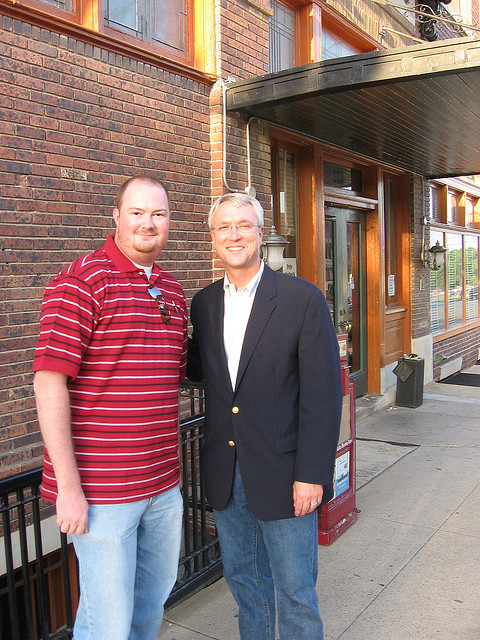
I talked with Jason Stanford, a spokesperson for the Chris Bell campaign and he got a comment from the candidate for me (it was technically for the paper, but thought it was worth sharing here):
“Today shows why this race will come down to me and Rick Perry. While the independent candidates have to get non-voters to sign petitions and spend millions build statewide networks from scratch, I’m campaigning across South Texas and uniting a proven grassroots army called the Texas
Democratic Party.”
With four candidates this fall it should be interesting.
From the e-mail files:
Amid all the hysteria among politicians and in the media over rising gasoline prices, and all the outraged indignation about oil company profits and their executives’ high pay and lavish perks, has anybody bothered to even estimate how much effect any of this actually has on the price we pay at the pump?